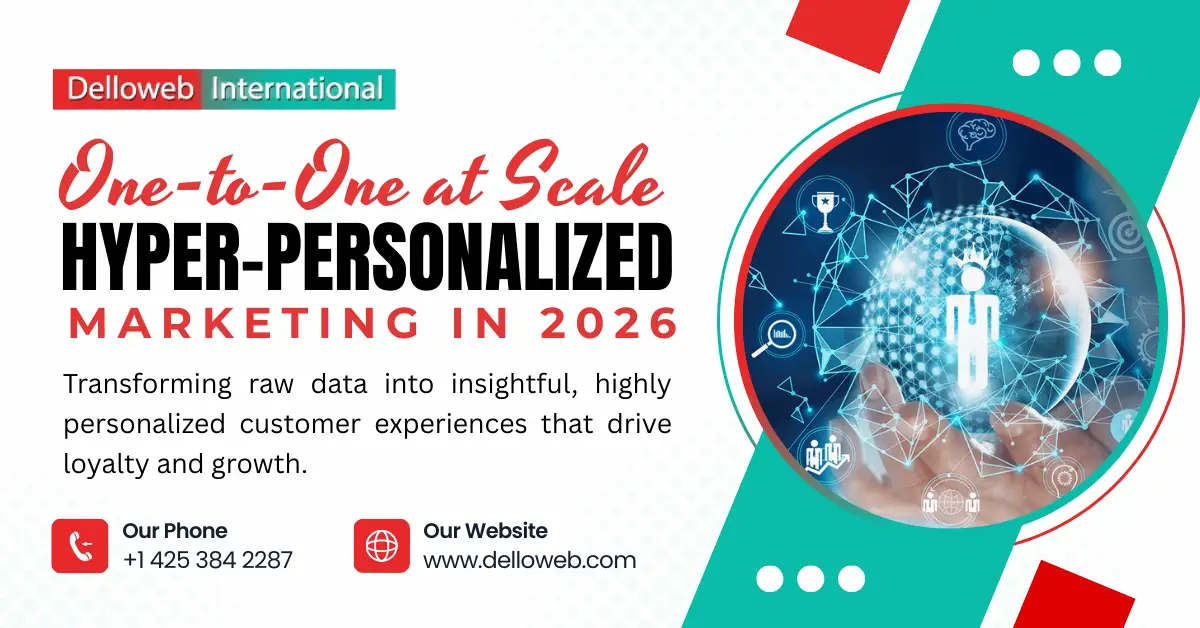
As digital landscapes evolve, businesses are shifting from broad segmentation to precision-driven engagement. In 2026, hyper-personalized marketing has become the undisputed cornerstone of modern brand strategy. Organizations are leveraging AI, automation, and advanced data modeling to deliver experiences that feel individually crafted. For companies committed to innovation, such as Delloweb, the shift toward deeper personalization is not just a trend—it is a competitive imperative.
What Is Hyper-Personalized Marketing?
Hyper-personalized marketing goes beyond traditional segmentation by using real-time data, behavioral analytics, and predictive intelligence to tailor each customer interaction. Unlike standard personalization, which may rely on static customer profiles, this approach adapts to every digital move a customer makes.
At its core, hyper-personalization relies on three foundational elements:
- AI personalization capabilities that predict user interests
- Dynamic content that adapts in real time
- Customer identity graphs that unify multi-channel behavior into a single profile
Why Hyper-Personalized Marketing Is Transforming 2026
The digital consumer of 2026 is informed, fast-paced, and expects relevance across all channels. Hyper-personalized marketing delivers on those expectations by creating seamless, context-aware experiences.
Key Drivers Behind the Shift
- Massive growth in AI personalization tools
- Demand for real-time dynamic content experiences
- Advancements in customer identity graphs for unified user insights
- Expanding first-party data strategies due to privacy regulations
For businesses, these drivers mean higher conversion rates, deeper loyalty, and more efficient marketing spend.
How AI Personalization Powers Hyper-Personalized Marketing
AI personalization sits at the center of hyper-personalization. It enables marketers to process large datasets in milliseconds and surface insights that human teams cannot achieve manually.
AI-Driven Personalization Tactics
- Predictive recommendations on websites and apps
- Real-time product suggestions based on user behavior
- Automated messaging flows across email, SMS, and social platforms
- Adaptive ad targeting aligned with user micro-behaviors
By integrating AI personalization into their technology stack, companies like Delloweb can deliver targeted, accurate, and scalable marketing experiences.
Dynamic Content: The Key to Real-Time Relevance
Dynamic content transforms generic campaigns into customized journeys. It ensures that every touchpoint—website banners, product listings, emails, or push notifications—adjusts automatically to reflect current user behavior.
Benefits of Dynamic Content
- Higher customer engagement
- Reduced bounce rates
- Increased retention
- Stronger purchase intent
Dynamic content is essential for any hyper-personalized marketing strategy because it allows brands to shift from static messaging to interactive, adaptive experiences.
Understanding Customer Identity Graphs
The rise of customer identity graphs in 2026 has given marketers an unprecedented advantage. These graphs consolidate fragmented user data from multiple channels—web, mobile, social, CRM, offline interactions—into one cohesive profile.
What Identity Graphs Enable
- Accurate customer journey mapping
- Better audience segmentation
- Cross-channel personalization at scale
- Precise behavioral prediction
Customer identity graphs provide the unified visibility required to execute successful hyper-personalized marketing campaigns.
The Business Impact of Hyper-Personalized Marketing
Brands adopting hyper-personalization are experiencing measurable performance improvements across core KPIs.
Common Results
- Higher conversion rates
- Increased customer lifetime value
- More effective retargeting
- Reduced customer acquisition costs
By combining AI personalization, dynamic content, and customer identity graphs, Delloweb enables organizations to build marketing ecosystems that respond instantly to user needs.
How Delloweb Helps Businesses Embrace Hyper-Personalized Marketing
Delloweb specializes in modern digital transformation solutions that empower brands to shift from generic messaging to intelligent, data-driven engagement. Our approach includes:
- End-to-end personalization strategy development
- Full integration of AI personalization frameworks
- Dynamic content deployment across all marketing channels
- Customer identity graph implementation and optimization
- Advanced analytics dashboards for performance tracking
With a structured and scalable methodology, Delloweb helps brands accelerate their hyper-personalized marketing capabilities and achieve sustainable growth.
Call to Action
If you want to elevate your customer engagement strategy and unlock the true potential of hyper-personalized marketing, Delloweb is ready to partner with you.
Contact us today to design a personalized digital roadmap that aligns with your business goals.
Frequently Asked Questions (FAQ)
What is hyper-personalized marketing?
It is an advanced marketing approach that uses AI personalization, dynamic content, and unified customer identity graphs to deliver highly customized experiences.
How does AI personalization improve marketing performance?
AI personalization analyzes real-time behavior and predicts user interests, enabling more accurate recommendations and messaging.
Why are customer identity graphs important?
Identity graphs connect fragmented customer data into a single profile, allowing brands to execute consistent cross-channel personalization.
Can dynamic content increase conversions?
Yes. Dynamic content boosts engagement by showing users messaging, products, and offers that match their real-time behavior.
How can Delloweb support my personalization strategy?
Delloweb provides strategy, technology integration, implementation, and analytics services to help brands adopt and scale hyper-personalized marketing.