
When people hear the words Google Ads, many immediately think about paid advertisements appearing at the top of Google Search. While that is certainly part of Google Ads, modern Google advertising is much more advanced than simply choosing a keyword, writing an advertisement and paying for clicks.
Google Ads uses a combination of machine learning, automated bidding, audience signals, advertising assets and responsive advertising formats to help businesses connect with potential customers at different stages of their buying journey.
This is one of the reasons Google Ads has become an important digital marketing channel for businesses of different sizes. A local business can use Google Ads to generate calls and enquiries, an ecommerce company can use it to drive product sales, a software company can generate leads, and a global organization can reach customers across multiple markets.
However, getting results from Google Ads is not simply about spending more money.
The real question is whether your campaign is reaching the right people, showing the right message, using the right bidding strategy and providing a clear path toward conversion.
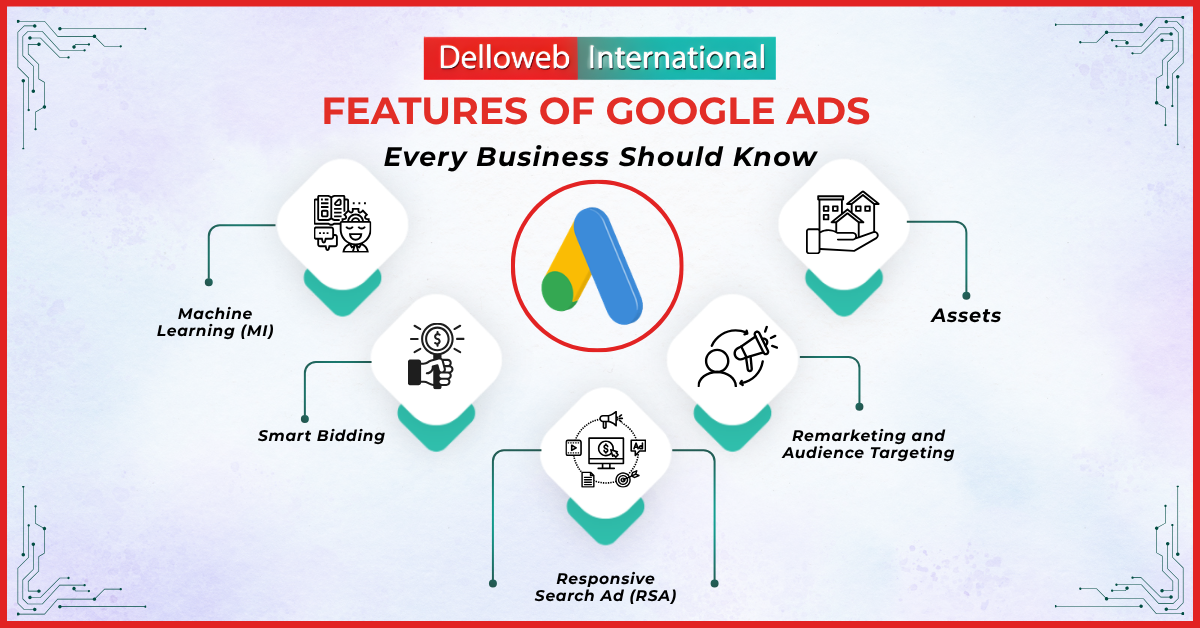
In this guide, we will explore five important features used in Google Ads:
- Machine Learning
- Smart Bidding
- Assets
- Remarketing and Audience Targeting
- Responsive Search Ads
The goal is to explain these features from a basic level and then move into deeper concepts so that business owners, marketers and beginners can understand how Google Ads works and why these features matter.
What Is Google Ads?
Google Ads is Google’s online advertising platform that allows businesses to promote their products and services across Google’s advertising ecosystem.
Depending on the campaign type and business objective, advertisements can appear in places such as Google Search, YouTube, Google Display Network and other Google advertising environments.
For example, imagine that someone searches for:
“Best ERP software for small business”
A business offering ERP software may create a Google Ads campaign designed to reach people searching for relevant solutions.
Another person may search:
“Cloud server for law firms”
A company offering cloud infrastructure for law firms could create advertising specifically designed around that search intent.
This is where Google Ads becomes different from traditional advertising.
Instead of showing the same message to everyone, businesses can build campaigns around search behaviour, audiences, locations, devices, business goals and many other signals.
Google describes audience targeting as a way to reach people based on factors such as who they are, their interests and habits, what they are researching and whether they have previously interacted with a business.
This creates an opportunity for businesses to put their message in front of people who are already showing interest in a product or service.
Why Understanding Google Ads Features Matters
A common mistake among beginners is to think that Google Ads success depends only on keywords.
Keywords are important, but they are only one part of the advertising process.
A successful Google Ads campaign needs several elements working together.
- Your advertisement needs to communicate the right message.
- Your landing page needs to provide the information promised by the advertisement.
- Your audience targeting needs to support your business objective.
- Your bidding strategy needs to make sense for your conversion goals.
- Your campaign needs accurate conversion tracking so that Google can understand which actions matter to your business.
- Your assets need to provide additional information that can help people take action.
The five features discussed below help connect these different parts of a Google Ads campaign.
1. Machine Learning in Google Ads
Machine learning is one of the most important technologies behind modern Google Ads.
In simple words, machine learning allows Google’s advertising systems to analyze large amounts of information and identify patterns that can help predict what may happen in an advertising auction or when a particular advertisement is shown.
For a beginner, think about it this way.
Suppose two people search for the same service.
Both users type similar keywords into Google, but their situations may be completely different.
One person may be searching from a mobile phone in Lahore during working hours.
Another person may be searching from a desktop computer in London late at night.
Their previous interactions with websites may also be different.
Google Ads can consider contextual information when determining how an advertisement may perform.
Google explains that Smart Bidding can use signals such as device, location, time of day, browser, operating system, language and other contextual information.
This does not mean that advertisers should simply launch a campaign and leave everything to automation.
Machine learning still needs good information.
- If conversion tracking is incorrect, Google may receive poor signals.
- If your landing page is weak, advertising traffic may not convert.
- If your campaign objective is unclear, optimization may move in the wrong direction.
- If your keywords and advertisement do not match user intent, the campaign may struggle to generate quality leads.
This is why machine learning should be viewed as a powerful part of Google Ads rather than a replacement for strategy.
How Machine Learning Helps Google Ads
Machine learning can help Google Ads make predictions based on available data.
For example, the system may learn that certain combinations of search behaviour, device, location and other contextual signals are more likely to result in a conversion.
As more relevant conversion data becomes available, automated systems can use that information to improve future decisions.
This becomes particularly important when a campaign has many auctions happening across different users and situations.
A human advertiser cannot manually calculate an ideal bid for every individual auction.
Google explains that Smart Bidding uses machine learning to optimize bids for each auction and can make millions of unique bidding decisions every second across campaigns.
A Simple Example
Imagine a software company wants to generate enquiries for its ERP software.
The company receives searches from:
- Small businesses
- Manufacturing companies
- Retail businesses
- Law firms
- Distributors
- International companies
Some searches may have a high probability of becoming leads while others may have a lower probability.
Machine learning helps Google’s systems evaluate available signals and make automated predictions about performance.
The advertiser’s job is to provide strong campaign structure, accurate conversion tracking, relevant advertising and useful landing pages.
The technology then has better information to work with.
Machine Learning Does Not Mean Set and Forget
This is an important point for business owners.
Automation does not eliminate the need for Google Ads management.
A campaign still needs human decisions about:
- Business goals
- Target markets
- Budget
- Keyword strategy
- Conversion definitions
- Landing pages
- Advertising messages
- Audience strategy
- Offer positioning
- Campaign structure
- Performance analysis
The strongest approach is usually a combination of human strategy and platform automation.
2. Smart Bidding
Smart Bidding is closely connected with machine learning, but the two terms should not be confused.
Machine learning is the technology used to analyze signals and make predictions.
Smart Bidding is a group of automated bidding strategies that uses Google’s machine learning technology to optimize for conversions or conversion value.
Google currently identifies Target CPA, Target ROAS, Maximize Conversions and Maximize Conversion Value as Smart Bidding strategies.
What Is Bidding in Google Ads?
Every time an eligible advertisement competes to appear, Google Ads determines an appropriate bid within the campaign’s bidding system.
Traditionally, advertisers had to spend significant time adjusting bids manually.
Modern Google Ads can automate much of this process.
Smart Bidding evaluates contextual signals and conversion information to help determine how aggressively to bid in individual auctions.
This is known as auction time bidding.
How Smart Bidding Works
Imagine a company wants to generate 100 qualified leads from Google Ads.
The company does not simply want traffic.
It wants people who are likely to become customers.
If conversion tracking is correctly configured, Google Ads can receive information about important actions such as:
- Form submissions
- Phone calls
- Purchases
- Signups
- Quote requests
- Other valuable customer actions
The bidding system can then optimize around the selected conversion goal.
This is fundamentally different from optimizing only for clicks.
A campaign can receive thousands of clicks and still produce poor business results.
The real value comes from meaningful conversions.
Maximize Conversions
Maximize Conversions is designed to help advertisers generate as many conversions as possible within the available campaign budget.
For example, a service company may want more enquiries.
Its conversion could be a completed contact form or a qualified phone call.
The campaign can be structured around generating more of those actions rather than simply collecting clicks.
Target CPA
Target CPA focuses on generating conversions around a target cost per acquisition.
For example, suppose a company determines that it can afford approximately $20 for a qualified lead.
The advertiser can use a Target CPA strategy when appropriate and when the campaign has enough useful conversion data to support automated bidding.
The target should be based on actual business economics rather than an arbitrary number.
If the average customer generates $1,000 in revenue and has a strong lifetime value, a higher acquisition cost may be acceptable.
If a customer generates only $50 in revenue, the acceptable acquisition cost may be much lower.
This is why Google Ads strategy should always connect with the business model.
Maximize Conversion Value
Not every conversion has the same value.
For an ecommerce company, one customer may purchase a product worth $50 while another customer purchases products worth $500.
Maximize Conversion Value allows advertisers to focus on the value generated by conversions rather than treating every conversion as identical.
Target ROAS
Target ROAS is useful when an advertiser wants to optimize toward a specific return on advertising spend.
For example, if a business spends $1 on advertising and wants to generate approximately $5 in conversion value, its target return is based on that business objective.
However, ROAS should not be viewed in isolation.
A campaign can have an impressive ROAS and still be less valuable than another campaign if the overall revenue or profit opportunity is small.
Conversion Tracking Is Essential
Smart Bidding depends heavily on conversion data.
Google specifically notes that conversion tracking is required when setting up Smart Bidding.
This makes conversion tracking one of the most important technical foundations of Google Ads.
If you tell Google that a page view is a conversion when your real business goal is a qualified sales enquiry, the system may optimize toward the wrong outcome.
Before using automated bidding, businesses should understand exactly what a successful conversion means.
3. Google Ads Assets
The third important feature is assets.
Many beginners still think of a Google Search advertisement as simply a headline and description.
Modern Google Ads provides many types of assets that can give potential customers additional information and additional ways to interact with an advertisement.
Google explains that assets can include headlines, descriptions, sitelinks, call buttons, location information and other business information.
What Are Google Ads Assets?
An asset is an additional piece of information that can become part of an advertisement.
Depending on the campaign and business, assets may include:
- Sitelinks
- Call assets
- Location assets
- Image assets
- Callout assets
- Structured snippets
- Business information
- Other eligible advertising components
The exact assets available can vary depending on campaign type, account settings and eligibility.
Why Assets Matter
Imagine that someone searches for a digital marketing agency.
One advertisement only contains a headline and description.
Another advertisement includes additional links such as:
- SEO Services
- Google Ads Management
- Website Development
- Contact Us
The second advertisement gives the user more possible ways to continue.
This can make the advertisement more useful because the user does not have to search through the website to find a relevant page.
Google recommends using every asset type that is relevant to the business and notes that assets can provide additional information and ways for customers to engage with advertisements.
Sitelink Assets
Sitelinks can direct users to specific pages of a website.
For example, a software company may use:
- ERP Software
- CRM Software
- Pricing
- Request a Demo
This helps users move directly toward information that matches their needs.
Call Assets
A business that depends heavily on phone enquiries can benefit from call assets.
For example, a local service company may want people to call immediately instead of visiting several pages.
The goal is to make the next action easier.
Location Assets
Businesses with physical locations can use location related information where eligible.
This can be particularly useful for local businesses that want customers to find their offices, stores or service locations.
Image Assets
Visual information can make Search advertising more noticeable.
Google’s current guidance recommends adding relevant image assets to responsive search campaigns where appropriate.
The important point is relevance.
An image should support the business message rather than simply being added because a visual is available.
Assets Are More Than Decoration
A common mistake is to treat assets as something optional that should be added at the end of campaign setup.
A better approach is to consider assets part of the advertisement strategy.
Ask:
- What information does the customer need?
- What pages should they visit?
- What action should they take?
- What makes the business different?
- What additional information can reduce uncertainty?
The answers can help determine which assets should be used.
4. Remarketing and Audience Targeting
The fourth feature shown in the Delloweb International image is remarketing and audience targeting.
There is an important terminology update here.
Google Ads now commonly uses the term your data for audience groups that were traditionally referred to as remarketing audiences.
The basic concept remains easy to understand.
People do not always become customers during their first visit.
Someone may discover your website today, read a few pages, compare different companies and leave.
That person may return tomorrow.
They may search for another provider.
They may need several days or weeks before making a decision.
Audience strategies can help businesses stay relevant during this journey.
What Is Audience Targeting?
Audience targeting allows advertisers to reach people based on different characteristics, interests, behaviours, research activity or previous interactions with a business.
Google describes audience targeting as a way to reach people based on who they are, their interests and habits, what they are researching and whether they have previously interacted with a business.
This allows advertisers to think beyond keywords.
Instead of asking only:
What keyword did this person search?
An advertiser can also consider:
Has this person already interacted with my business?
Are they actively researching this type of product?
Are they likely to need this service?
Have they visited an important page before?
These questions can lead to more sophisticated campaign strategies.
How Remarketing Works
Suppose someone visits a website selling business software.
- They read the ERP page.
- They look at the features.
- They visit the pricing page.
- Then they leave without requesting a demo.
With appropriate tracking and audience setup, that visitor may become part of a relevant data segment.
The business can then create campaigns designed to reconnect with eligible previous visitors.
Google explains that data segments can be used to re engage people who previously interacted with a business across supported Google advertising environments.
Remarketing Is Not Only for Ecommerce
Many people associate remarketing with online stores.
For example:
- A customer views a laptop.
- Leaves the website.
- Later sees an advertisement for that product.
- But remarketing can also be useful for service businesses.
- Consider a company offering:
- ERP software
- Cloud hosting
- Legal technology
- Website development
- Digital marketing
- Business automation
- Mobile application development
A potential customer may need several interactions before making a decision.
Remarketing can help keep the brand visible during that consideration period.
Audience Targeting and Search Campaigns
Audience data can also support Search campaigns.
Google explains that first party audience segments added under the Observation setting can be used as signals for Smart Bidding strategies.
This is an important concept.
Observation does not necessarily restrict the campaign to only that audience.
Instead, it can provide information about how different audience segments perform.
This can help advertisers understand which groups are more valuable and make better campaign decisions.
Targeting Versus Observation
These two settings are important to understand.
Targeting means you want the campaign or ad group to focus on selected criteria.
Observation allows you to monitor performance for selected criteria without restricting the campaign’s reach in the same way.
Google recommends Observation for audiences in Search campaigns because it can provide useful performance information without unnecessarily limiting reach.
For beginners, the simplest way to remember the difference is:
Targeting controls who you want to reach.
Observation helps you understand who is responding.
This distinction becomes very useful when managing mature Google Ads campaigns.
5. Responsive Search Ads
The fifth feature shown in the image is Responsive Search Ads, commonly called RSAs.
Responsive Search Ads changed the traditional way advertisers create Search advertisements.
Instead of creating one fixed combination of headline and description, advertisers provide multiple headlines and descriptions.
Google Ads can then test combinations and learn which combinations are more relevant to different searches.
What Is a Responsive Search Ad?
A Responsive Search Ad is a Search advertisement that can adapt its messaging by combining different headlines and descriptions.
Google currently allows up to 15 headlines and 4 descriptions in a Responsive Search Ad.
This gives the system multiple possible combinations.
For example, a software company could provide headlines such as:
- ERP Software for Growing Businesses
- Manage Your Business From One Platform
- Powerful Business Management Software
- Request an ERP Demo
- Complete ERP Solution
The descriptions could explain:
Manage finance, inventory, sales, customers and business operations through one integrated platform.
A flexible advertising system can then combine eligible assets to create relevant ad variations.
Why Responsive Search Ads Matter
Imagine that a user searches:
“ERP software for manufacturing”
Another searches:
“business management software Pakistan”
Another searches:
“ERP system for small business”
The same business may want its advertisement to communicate different aspects of its offering depending on the user’s search.
Responsive Search Ads provide more combinations for Google’s systems to evaluate.
Google explains that Responsive Search Ads test different combinations over time and learn which combinations perform best.
Writing Better Responsive Search Ads
Responsive advertising does not mean that every headline should say the same thing.
A strong RSA should contain variety.
For example, different headlines can focus on:
- The main service
- Customer benefit
- Business problem
- Location
- Trust
- Industry
- Call to action
- Unique selling point
- Relevant keyword
Descriptions can provide more context and answer the user’s basic question.
The goal is not to fill every available space with repeated keywords.
The goal is to give Google useful, relevant and genuinely different messaging options.
The Importance of Ad Strength
Google Ads provides an Ad Strength indicator for Responsive Search Ads.
It provides feedback about the quality and variety of the assets supplied.
Google currently recommends having Responsive Search Ads with Good or Excellent Ad Strength and using relevant, unique assets.
However, advertisers should understand what Ad Strength means.
It is not the same thing as guaranteed business performance.
A strong Ad Strength does not automatically mean that a campaign will generate profitable leads.
Keyword relevance, landing page quality, offer strength, conversion tracking, competition and business economics still matter.
Google itself notes that Ad Strength primarily evaluates the relationship between the assets and the targeted keywords rather than external factors such as landing page quality or the value of the offering.
This is an important distinction for anyone learning Google Ads.
How These Five Google Ads Features Work Together
The real power of Google Ads becomes easier to understand when these features are viewed as parts of one system.
Imagine a company wants to generate leads for its software solution.
The campaign could work like this.
Step 1: Understand the Customer
The business identifies its ideal customers and the searches they are likely to make.
This provides the foundation for keyword and audience strategy.
Step 2: Create Relevant Responsive Search Ads
The advertiser creates multiple relevant headlines and descriptions.
These assets communicate the service, benefits, differentiators and calls to action.
Step 3: Add Relevant Assets
Sitelinks, call assets, images and other suitable assets provide additional information and possible paths for users.
Step 4: Configure Conversion Tracking
The business defines what counts as a valuable conversion.
This could be a purchase, enquiry, phone call, demo request or another meaningful business action.
Step 5: Use Smart Bidding
Once suitable conversion data is available, an appropriate Smart Bidding strategy can help optimize bids toward the campaign goal.
Step 6: Use Audience Data
The advertiser studies how different audience segments perform and can use first party data where appropriate.
Step 7: Let Machine Learning Assist Optimization
Google’s systems can process signals and performance data at a scale that would be difficult to manage manually.
The advertiser then continues to review results, improve strategy and make business decisions.
This is the real relationship between automation and human expertise.
Google Ads Is Not Just About Getting Clicks
One of the biggest misunderstandings about Google Ads is that more clicks automatically mean better performance.
That is not necessarily true.
Suppose one campaign receives 10,000 clicks and produces 20 enquiries.
Another campaign receives 3,000 clicks and produces 100 enquiries.
The second campaign may be much more valuable even though it received fewer clicks.
This is why businesses should focus on meaningful outcomes.
Depending on the business, those outcomes could include:
- Sales
- Qualified leads
- Phone calls
- Demo requests
- Bookings
- Purchases
- Registrations
- Quote requests
- Revenue
- Profit
The correct conversion goal depends on the business model.
Common Google Ads Mistakes Businesses Should Avoid
Understanding the five features is useful, but implementation matters even more.
Here are several mistakes businesses should avoid.
Using Only Broad Traffic Goals
Traffic can be useful, but businesses should understand whether those visitors are actually helping achieve the business objective.
Ignoring Conversion Tracking
Without reliable conversion data, automated optimization may not have the information required to work toward the right business outcome.
Using Weak Landing Pages
A good advertisement cannot fix a poor landing page.
If the advertisement promises one thing and the landing page provides something different, users may leave without converting.
Repeating the Same Ad Message
Responsive Search Ads need useful variation.
Repeating the same headline with minor wording changes gives the system fewer meaningful options.
Ignoring Assets
Relevant assets can provide more information and additional ways for users to interact with an advertisement.
Targeting Everyone Without a Strategy
A worldwide campaign may sound attractive, but different countries, languages, markets and customer behaviours can have very different economics.
A business should understand where its customers actually come from.
Measuring Only Cost Per Click
A low cost per click is not automatically a sign of success.
A cheaper click that never becomes a customer may be less valuable than a more expensive click that produces a profitable sale.
How Businesses Can Build a Better Google Ads Strategy
A strong Google Ads campaign starts with the business rather than the advertising platform.
Before launching a campaign, answer these questions.
What Are You Selling?
Be specific.
Who Is Your Ideal Customer?
Define the type of customer most likely to benefit from your product or service.
What Problem Are You Solving?
People search Google because they have questions, problems or needs.
Your advertisement should connect with that intent.
What Action Do You Want?
Do you want a sale, phone call, form submission, demo request or booking?
What Makes Your Business Different?
Your advertising should communicate a genuine reason for customers to choose you.
Which Locations Matter?
Do you serve Lahore, Karachi, Islamabad, Multan, all of Pakistan or international markets?
Your campaign structure should reflect your actual service area.
What Is a Valuable Conversion?
This is one of the most important questions in the entire campaign.
If you cannot clearly define a valuable conversion, automated optimization becomes much harder to evaluate.
The Future of Google Ads
Google Ads continues to become more automated and data driven.
Machine learning, automated bidding, responsive advertising and audience signals are becoming increasingly important.
Google is also integrating advertising into newer Search experiences. Google currently states that eligible advertisements can appear above, below or within AI Overviews in supported markets, including Pakistan for English language experiences.
This means advertisers should not think about Google Ads as a static advertising system.
The platform continues to evolve.
However, one principle remains important.
Technology can help deliver and optimize advertising, but businesses still need strong strategy, useful offers, clear messaging, accurate measurement and valuable customer experiences.
Final Thoughts
Google Ads has developed far beyond simple keyword advertising.
Machine learning helps Google’s systems process large amounts of information.
Smart Bidding helps automate bidding decisions around conversion goals.
Assets provide additional information and ways for customers to interact with advertisements.
Audience targeting and remarketing help businesses stay connected with people based on their interests and previous interactions.
Responsive Search Ads allow advertisers to provide multiple messages that Google can combine and test for different searches.
But these features should not be treated as isolated tools.
They work best when they are supported by a clear marketing strategy, accurate conversion tracking, relevant advertising, strong landing pages and a genuine understanding of the customer.
For businesses, the ultimate goal should not simply be to appear on Google.
The goal should be to appear in front of the right people, communicate the right message, generate meaningful actions and turn advertising investment into measurable business growth.
At Delloweb International, we believe digital advertising should be connected with the wider business strategy rather than treated as a source of random website traffic. A well planned Google Ads campaign can become a valuable part of a broader digital growth strategy when the targeting, messaging, tracking and conversion journey are properly aligned.
If your business is planning to start Google Ads, improve an existing campaign or generate more qualified leads through paid search, the first step is to understand what your customers are actually searching for and what action you want those customers to take.
Once that foundation is clear, the technology becomes much more powerful.
Delloweb International helps businesses build and improve digital solutions designed around real business goals, customer needs and measurable growth.

