
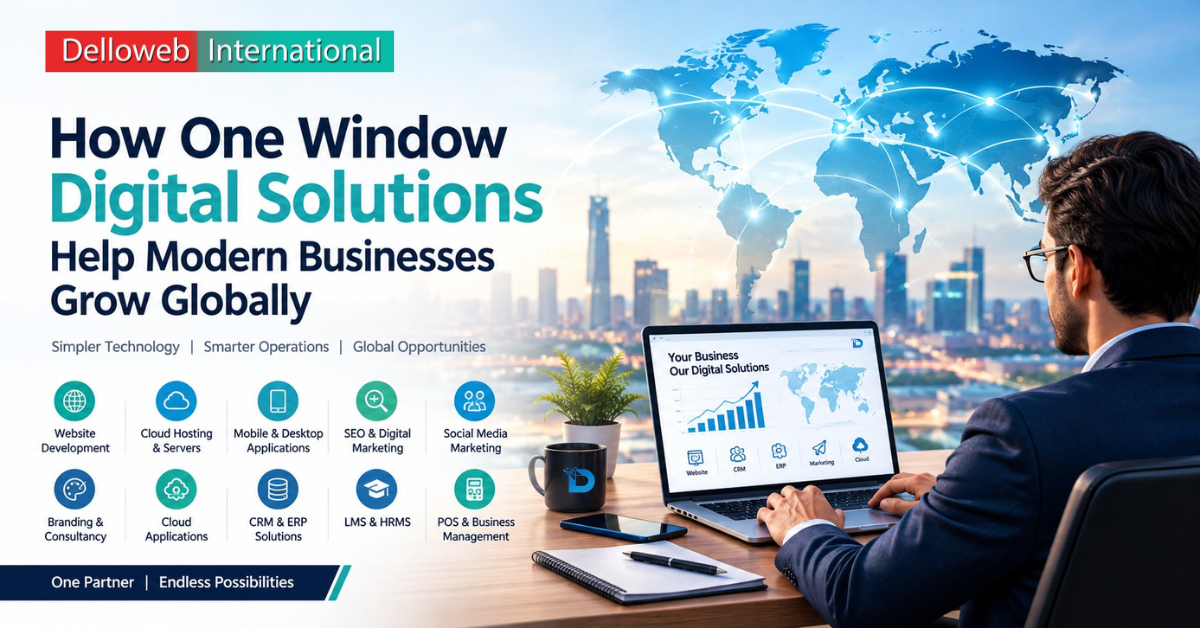
Running a modern business is no longer only about having a good product or service. Businesses today need a strong digital presence, reliable technology, efficient internal systems, secure data, effective marketing, and simple ways to communicate with customers.
As businesses grow, they often start using different companies and platforms for different needs. One company develops the website. Another provides hosting. Someone else manages digital marketing. A separate software provider handles CRM or ERP. Another team may develop a mobile application.
This approach can work, but it can also create unnecessary complexity.
This is where one window digital solutions can make a meaningful difference.
A one window digital solutions provider brings multiple technology, software, cloud, marketing, and business services together under one roof. Instead of managing many disconnected providers, a business can work with one technology partner that understands its overall goals.
For modern businesses that want to compete locally and internationally, this approach can make digital growth more organized, scalable, and manageable.
What Are One Window Digital Solutions?
One window digital solution means getting multiple business technology and digital services from one trusted provider.
Instead of searching for separate companies for website development, hosting, cloud infrastructure, software development, CRM, ERP, SEO, branding, and digital marketing, a business can access these services through one digital solutions partner.
The purpose is not simply to offer more services.
The real purpose is to connect different parts of a business so they can work together.
For example, a company may need:
• A professional business website
• Cloud hosting and server management
• CRM software for customer management
• ERP software for business operations
• Mobile or desktop applications
• SEO and digital marketing
• Social media management
• Branding and design
• Business automation
• Cloud applications
• POS or business management systems
When these solutions are planned together, technology can become a business growth tool instead of becoming another operational challenge.
Why Businesses Need Digital Solutions Today
Customers have changed the way they discover, compare, contact, and purchase from businesses.
A potential customer may first discover a company through Google, social media, a business directory, an advertisement, or a recommendation. They may then visit the website, contact the business through WhatsApp, submit a form, download an application, or request a quotation.
This means a business needs more than a physical presence.
It needs a connected digital presence.
At the same time, business operations are becoming more technology driven. Customer information, sales, invoices, inventory, employees, documents, communications, reports, and marketing activities may all require digital systems.
Without the right technology, businesses can spend unnecessary time managing repetitive tasks and disconnected information.
Digital solutions can help businesses organize these processes and create a stronger foundation for growth.
From Basic Digital Presence to Digital Business Infrastructure
A common mistake is to think that digital transformation simply means creating a website.
A website is important, but it is only one part of a modern digital business.
A growing company may eventually need a complete digital infrastructure that includes its website, hosting, applications, internal software, customer management, marketing, analytics, cloud systems, and automation.
- Think of it as a connected ecosystem.
- The website helps people discover the business.
- Digital marketing helps bring relevant visitors.
- CRM helps manage customer relationships.
- ERP helps manage business operations.
- Cloud infrastructure helps keep applications and data accessible.
- Automation helps reduce repetitive work.
- Mobile and desktop applications can extend business services to employees and customers.
When these components are planned around the same business objectives, technology becomes much more valuable.
Website Development Is the Foundation of Digital Growth
For many businesses, the website is the first major step toward building a professional digital presence.
A business website can explain what the company does, display products and services, answer customer questions, generate enquiries, support online sales, and establish trust.
However, a modern business website should be more than an attractive collection of pages.
It should be designed around users and business objectives.
Important considerations include:
• Clear navigation
• Mobile responsiveness
• Fast loading performance
• Search engine optimization
• Useful and original content
• Clear calls to action
• Contact and enquiry options
• Secure hosting
• Technical reliability
• Easy content management
A website should answer an important question quickly:
Why should a potential customer choose this business?
The answer should be clear through the content, structure, services, evidence, and overall user experience.
Cloud Hosting and Reliable Infrastructure
As a business becomes more dependent on digital systems, reliable infrastructure becomes increasingly important.
Websites, applications, CRM systems, ERP platforms, databases, files, and business tools all need an environment where they can operate securely and reliably.
Cloud hosting and cloud servers can provide businesses with flexible infrastructure that can support changing requirements.
For example, a growing company may begin with a relatively small website and later require more server resources because of increased traffic or additional applications.
A scalable cloud environment can make it easier to adapt to these changes.
Cloud solutions can also support remote access, centralized systems, backups, application hosting, and collaboration, depending on how the infrastructure is designed.
The important point is that cloud technology should be selected according to the actual requirements of the business rather than simply because cloud computing is popular.
CRM: Turning Customer Information into Better Relationships
Customer relationships are at the heart of almost every business.
A CRM, or Customer Relationship Management system, helps businesses organize customer information and interactions in one place.
Without a proper CRM, customer information may be scattered across spreadsheets, emails, messaging applications, notebooks, and different employees’ devices.
This can make it difficult to understand the complete customer journey.
A CRM can help businesses manage:
• Customer profiles
• Leads
• Follow ups
• Sales opportunities
• Communication history
• Proposals
• Invoices
• Tasks
• Customer service activities
• Reports
The value of CRM is not simply storing customer information.
The real value comes from using organized information to improve communication and decision making.
ERP: Connecting Business Operations
As a business grows, managing different departments separately can become difficult.
This is where ERP, or Enterprise Resource Planning, can become useful.
An ERP system can bring different business functions together within a connected platform.
Depending on the business, an ERP may include:
• Sales
• Purchasing
• Inventory
• Accounts
• Invoicing
• Manufacturing
• Human resources
• Payroll
• Reporting
• Customer management
• Production
• Business workflows
The exact requirements differ from one industry to another.
A manufacturing company may need production and inventory management, while a service company may require project management, customer management, billing, and workflow automation.
Good business software should therefore be built around actual business processes.
Business Automation Reduces Repetitive Work
Many businesses still spend valuable working hours on repetitive tasks.
Employees may manually enter information into multiple systems, prepare similar documents, send routine messages, update spreadsheets, or transfer information between departments.
Automation can reduce some of this unnecessary manual work.
For example, when two systems are properly integrated, information entered into one system may be transferred automatically to another system.
Ecommerce businesses can benefit from integrations between their online stores and CRM or ERP platforms. Customer orders, products, inventory information, invoices, and other relevant data can be connected according to the business workflow.
The goal of automation is not to replace people.
It is to allow people to spend more time on work that requires communication, creativity, analysis, and decision making.
Mobile and Desktop Applications Extend Business Capabilities
Customers and employees increasingly expect services to be available through convenient digital channels.
Mobile applications can provide customers with direct access to products, services, accounts, bookings, notifications, and other features.
Desktop applications can also be useful for businesses that require specialized workflows or operational tools.
Depending on the business model, applications can support:
• Customer services
• Sales
• Internal operations
• Communication
• Booking systems
• Ecommerce
• Business management
• Reporting
• Employee workflows
The right application depends on the problem that needs to be solved.
Technology should follow the business requirement, not the other way around.
SEO Helps Businesses Become Discoverable
Building a website is only the beginning.
If potential customers cannot find that website, its business value can remain limited.
Search Engine Optimization, commonly known as SEO, helps businesses improve their visibility in search engines.
Effective SEO involves much more than adding keywords to a page.
It can include:
• Search intent research
• Useful content
• Website structure
• Technical SEO
• Page titles and descriptions
• Internal linking
• Image optimization
• Local SEO
• Website performance
• Authority and trust signals
• Regular content development
Modern search engines are increasingly focused on whether content genuinely helps users.
That means businesses should create content for people first and optimize it for search engines without sacrificing clarity or usefulness.
Digital Marketing Brings the Right Audience
SEO is only one part of digital marketing.
Businesses may also use social media marketing, paid advertising, content marketing, email marketing, local marketing, and other digital channels depending on their goals.
The important question is not simply:
How can we get more traffic?
A better question is:
How can we reach the right people and turn relevant attention into genuine business opportunities?
This distinction matters.
Thousands of visitors who have no interest in a company’s services may provide less value than a smaller audience that genuinely needs those services.
Digital marketing should therefore be connected to business objectives such as leads, enquiries, sales, customer retention, brand awareness, or market expansion.
Branding Builds Recognition and Trust
Technology can help people find a business, but branding helps them remember it.
A strong brand gives a business a consistent identity across its website, social media, applications, marketing materials, presentations, and customer communication.
Branding can include:
• Logo design
• Brand identity
• Typography
• Visual style
• Marketing materials
• Digital assets
• Brand messaging
• Brand guidelines
Professional branding does not mean making everything complicated.
Often, consistency is more important than complexity.
When customers repeatedly see a consistent and professional identity, it becomes easier to recognize the business across different digital channels.
Why One Technology Partner Can Simplify Growth
Working with multiple technology providers is not always a problem. In some situations, specialist providers may be exactly what a company needs.
However, managing many providers can create coordination challenges.
One team may not know what another team has implemented. A website developer may not understand the CRM structure. A marketing team may not know how leads are managed internally. A hosting provider may not understand the application’s business requirements.
A one window digital solutions provider can help reduce this communication gap.
One partner can understand the broader technology environment and help connect different services around the same business objectives.
This can make communication simpler and can reduce the effort required to coordinate multiple digital projects.
How One Window Digital Solutions Support Global Business Growth
Global growth is not simply about selling in another country.
A business entering international markets may need to consider websites, localization, customer communication, digital marketing, payment systems, applications, hosting infrastructure, branding, data management, and operational processes.
Different markets can also have different customer expectations and business requirements.
A strong digital foundation can make expansion easier to manage.
For example, a business may use its website to present services internationally, cloud infrastructure to support digital operations, CRM to manage international leads, digital marketing to reach specific markets, and business software to organize internal operations.
Technology does not automatically create international growth.
But the right technology can remove barriers that make growth more difficult.
Digital Transformation Is a journey, not a Single Project
Businesses sometimes approach digital transformation as one large project.
In reality, digital transformation is usually a gradual process.
A small business might start with:
- A professional website
- Business email and hosting
- Search engine optimization
- Social media presence
As the company grows, it may add:
- CRM
- Business automation
- Cloud applications
- ERP
- Mobile applications
- Advanced reporting and integrations
This gradual approach can allow a business to invest in technology according to its actual needs.
The objective is not to purchase every possible digital solution.
The objective is to build the right digital environment for the business.
How to Choose the Right Digital Solutions Provider
Choosing a digital solutions provider is an important business decision.
Price is one factor, but it should not be the only factor.
Businesses should also consider:
Understanding of Business Requirements
A technology provider should first understand the business problem before recommending a solution.
Technical Experience
Look for practical experience in the technologies and services required for the project.
Scalability
The solution should be capable of supporting future business requirements where appropriate.
Security
Websites, applications, customer information, and business data should be handled with appropriate security practices.
Communication
Clear communication is essential, particularly for long term technology projects.
Support
Businesses should understand what support and maintenance options are available after implementation.
Integration Capability
Modern businesses often use several systems. The ability to integrate those systems can be important for reducing duplicate work.
Industry Understanding
A solution designed around the actual industry and workflow can be more useful than a generic system that does not match the business process.
The Importance of Human Expertise in Digital Transformation
Technology alone does not solve business problems.
People do.
A successful digital project requires understanding the business, identifying the problem, selecting the appropriate technology, implementing it correctly, and continuously improving it.
This is why experience, communication, problem solving, and understanding of business processes matter alongside technical skills.
A good digital solutions partner should not simply ask:
What software do you want?
The better question is:
What problem are you trying to solve?
That question can lead to a much more practical technology strategy.
Delloweb International: One Window Digital Solutions for Modern Businesses
Delloweb International provides digital and technology solutions designed to help businesses build, manage, and grow their digital operations.
Its services cover different stages of the digital business journey, including website development and design, cloud hosting, servers, mobile and desktop application development, SEO and digital marketing, social media marketing, branding, cloud applications, CRM, ERP, LMS, POS, and other business management solutions.
The goal is to bring these capabilities together so businesses can access the technology they need without treating every digital requirement as a completely separate project.
Delloweb International works with businesses that need practical digital solutions for their websites, operations, customer management, marketing, automation, hosting, and software requirements.
Whether a company is establishing its first professional online presence or expanding an existing digital infrastructure, the right approach begins with understanding the business and then selecting technology that supports its goals.
What Businesses Can Gain from a Connected Digital Strategy
A connected digital strategy can help businesses create a more organized technology environment.
Potential benefits include:
• Better customer management
• More organized business operations
• Reduced repetitive work
• Improved communication
• Stronger online visibility
• Easier access to business information
• Better workflow management
• More scalable digital infrastructure
• Stronger brand presence
• Improved opportunities for international reach
These benefits depend on how well the solutions are planned, implemented, maintained, and aligned with the business.
Technology itself is not the complete answer.
The strategy behind the technology matters just as much.
Frequently Asked Questions
What does one window digital solutions mean?
One window digital solution means accessing multiple digital, software, cloud, marketing, and technology services through one provider instead of managing several unrelated providers.
Why is a website important for a modern business?
A website provides a central digital presence where customers can learn about a business, explore its services or products, contact the company, and take actions such as requesting information or making a purchase.
What is the difference between CRM and ERP?
CRM primarily focuses on customer relationships, leads, sales, and customer interactions. ERP focuses more broadly on business operations such as inventory, purchasing, accounts, production, HR, sales, and other organizational processes.
Can small businesses benefit from digital transformation?
Yes. Digital transformation does not have to begin with a large or expensive system. A small business can start with the digital tools it actually needs and gradually add more solutions as it grows.
How can digital solutions help a business reach international customers?
A professional website, SEO, digital marketing, cloud infrastructure, customer management systems, applications, and strong branding can help businesses establish and manage a digital presence across different markets.
Is one digital solutions provider better than using several providers?
The right approach depends on the business. Some companies benefit from specialized providers, while others prefer one partner that can manage multiple connected requirements. Businesses should evaluate their technical needs, project complexity, communication requirements, budget, and long-term plans.
What should a business consider before investing in new technology?
A business should first identify the problem it wants to solve, understand its current workflow, define its objectives, consider future requirements, evaluate security and integration needs, and then select technology that supports those requirements.
Final Thoughts
Modern business growth increasingly depends on how effectively a company uses technology.
A website can create an online presence. SEO can improve discoverability. Digital marketing can reach potential customers. CRM can organize customer relationships. ERP can connect business operations. Cloud infrastructure can support digital services. Automation can reduce repetitive work. Applications can create new ways for customers and employees to interact with a business.
The real opportunity comes when these technologies are not treated as isolated tools but as parts of a connected business strategy.
That is the idea behind one window digital solutions.
For businesses looking to grow locally, expand internationally, improve internal operations, or build a stronger digital foundation, the first step is not choosing the biggest technology stack.
It is understanding what the business needs today and where it wants to go tomorrow.
Delloweb International helps businesses explore, build, connect, and manage digital solutions designed around their individual requirements.
If your business is ready to improve its digital presence, automate operations, strengthen customer management, or build a scalable digital infrastructure, explore the digital solutions available through Delloweb International.

